

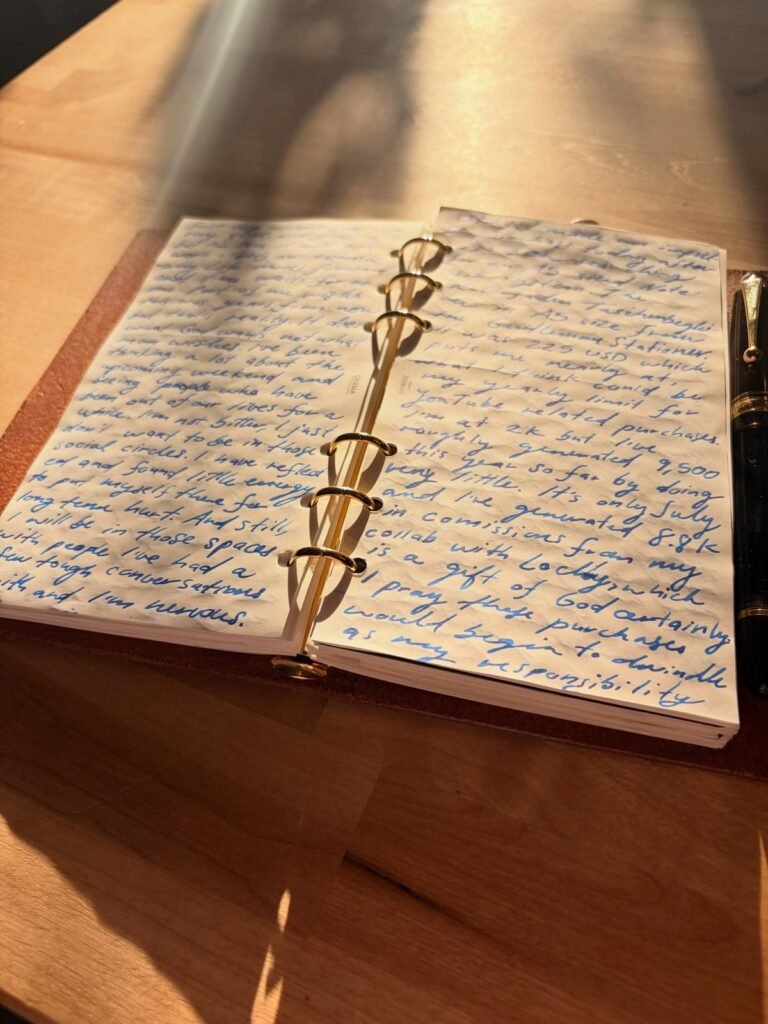
Some talks stall the moment they start out loud. Writing slows the same conversation down and takes the heat out of it.
A couples journal is one shared notebook where you both write a few honest lines at a time. With the right couples journal prompts, even a quiet Tuesday gives you something real to say.
Nobody interrupts a page. Nobody has to find the perfect words on the spot.
You write, your partner reads, and the reply comes when they are ready. If talking face to face feels easier on some days, keep a few conversation starters nearby for those nights instead.
What a Couples Journal Is (and What It Is Not)
A couples journal is a notebook that belongs to both of you. You take turns writing in it, a few lines or a full page, and the other person reads it later.
It is not a diary that only one of you reads. Nothing in it is secret from your partner, and that is the point.
It is not a complaint file either. Hard things can go in, but so can thanks, small jokes, and good news.
And it is not homework. Nobody grades your spelling, and a short honest entry beats a long forced one every time.
Step 1: Pick Your Format
One shared notebook, passed back and forth. This is the classic way, and it is our pick. One person writes, leaves the notebook in the agreed spot, and the other reads and replies when they are ready.
Two notebooks, one shared prompt. You each keep your own notebook and answer the same prompt on the same night. Then you swap and read each other’s page.
A shared doc on a phone or computer. This works best for long distance couples or partners who travel for work. It is less cozy than paper, but it keeps the habit alive when you are apart.
Pick the one you will both actually use. The best format is the one that does not get forgotten in a drawer.
Step 2: Set a Routine You Will Actually Keep
Choose a rhythm before you write a single word. Five minutes a day is enough for most couples.
If daily feels like too much, try three nights a week. One longer entry on a Sunday night also works well.
Keep the notebook in one passing spot, like a pillow or the bedside table. When it sits there waiting, it quietly reminds the next person that it is their turn.
Date every entry, even the short ones. Months from now, the dates turn your couples journal into a small history of your year.
Use a different pen color each. When the handwriting and the color both change down the page, it is easy to see who said what.
Step 3: Agree on the Ground Rules First
Five minutes of rules now saves hurt feelings later. Agree on these before the first entry goes in.
- No editing. Never cross out, correct, or rewrite your partner’s words, not even the spelling.
- No ammunition. Old entries never get quoted back in the middle of an argument.
- Honest, not cruel. You can write almost anything if you write it with care. For topics that run deep, the couples journal is a safe place to start, much like working through deep questions for couples together.
- A no reply option. Either of you can write “just read this, no reply needed” at the top of an entry. The other person reads it and lets it rest.
- Short counts. Two true lines are a real entry. Length is not the goal.
Your First 14 Days of Couples Journal Prompts
Use one prompt a day for your first two weeks. Write your answer, pass the notebook, and let your partner answer the same prompt after you.
- One thing your partner did recently that you appreciated, and why it mattered.
- A favorite small moment from this week.
- Something you are looking forward to doing together.
- A memory from early in the relationship that you never want to forget.
- One way your partner made your day easier this week.
- Something you have been thinking about but have not said out loud yet.
- What a perfect ordinary day together looks like to you.
- One thing you admire about how your partner handles hard days.
- A dream you have for the next year, big or small.
- Something you want the two of you to do more of, plus one idea for it.
- A worry you carry, and what kind of support actually helps.
- What feeling loved looks like for you in small daily ways.
- One thing you want to work on as a couple, said kindly.
- The entry you would want your partner to reread on a hard day.
The 3-Line Daily Prompt for Busy Days
Some days a full prompt is too much. On those days, write just three lines.
Line one is one thing you appreciated today. Line two is one honest feeling, plain and simple. Line three is one small wish for tomorrow.
It takes two minutes, and it never really gets old. The shape stays the same, but your answers change with your days.
How to Keep It Going After Week Two
- Take turns choosing the prompt. Your couples journal should feel shared, not assigned by one person.
- Reread together once a month. Pick a quiet night and go back over the early pages. They will surprise you.
- Count the small entries. A two line entry still counts, and small and steady beats big and rare.
- Skip the apology page. Missed a day? Just write the next entry and keep moving.
Conclusion
A couples journal asks very little of you: one notebook, a pen each, and a few honest lines. The couples journal prompts above carry your first two weeks, and the 3 line habit can carry the rest.
Start tonight with day one. Leave the notebook on your partner’s pillow and see what comes back.
And when you are ready for a longer talk, the 36 questions to fall in love make a beautiful next step.
FAQs
Is a paper notebook better than a phone?
For most couples, yes. Paper sits in a shared spot where both of you see it, and it never buzzes with other messages.
A phone doc is still better than nothing. It is also the right call when you live apart or travel a lot.
What if my partner only writes one or two lines?
That is fine, and it is more common than you think. Some people simply think in short lines.
Read what is there, reply warmly, and never grade the length. Short and honest is a real entry.
Should we read the entries out loud or in silence?
Most couples read in silence, each in their own time. It gives the reader space to sit with the words.
Reading a favorite entry out loud now and then can still be a sweet moment. Save it for the good ones.
What if an entry hurts my feelings?
Pause before you reply, and try the kindest reading first. Writing under stress can sound harsher than it was meant to.
Then answer calmly in the couples journal, or ask to talk about that one entry in person. The ground rules exist for exactly this moment.
How long should each entry be?
Long enough to be honest, and no longer. Most entries land between three lines and one page.
If you are using couples journal prompts, a few solid sentences per prompt is plenty. Stop when you have said the true thing.
2 Comments